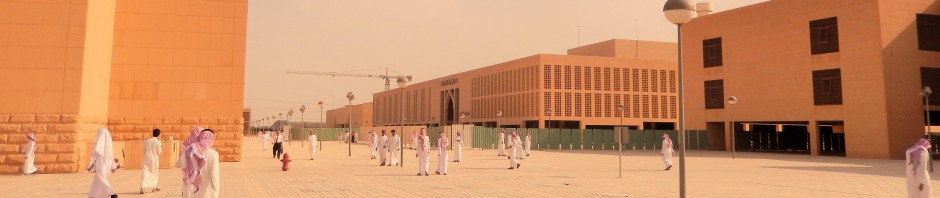
Saudi Arabia is living in the 1400s. No, I mean that literally. The year on the Hijri calendar is now 1436. Dictated by the cycles of the moon, year 1 started when the prophet Muhammad emigrated from Mecca (around 632 AD). In the Kingdom, this and the international Gregorian calendar are sometimes used side by side, though Saudis get along just fine within their borders without learning the Gregorian calendar—just like many Americans get along fine without learning the metric system, which everyone else (including Saudi Arabia) uses.
Same with numbers—most of the world uses the Western Arabic system (1 2 3 4 5 6 7 8 9), while parts of the Arab world write numbers the Eastern Arabic way (١ ٢ ٣ ٤ ٥ ٦٧ ٨ ٩). Despite the fact that Saudi Arabia is much more globalized than it was a few decades ago and uses Western Arabic numerals on most street signs, many Saudis still prefer using the Eastern Arabic numerals. Even in a place as globalized and bilingual as the polished cellphone store selling iPhones and Samsung Galaxies at the Riyadh airport, the man behind the counter copied my passport number into Eastern Arabic numerals while he was filling out the form for my new SIM card.
It should not come as a surprise then that the university I work for labels its room numbers in the local system, much to the chagrin of the foreign Westerners struggling to find their classrooms. On multiple occasions I have had to help a British teacher find his room numbers in the School of Languages and Translation. “They’ve really got to put the western numbers up in here—how are we supposed to read this shit?” he complained. I laughed and shook my head in commiseration, yet then I couldn’t help but imagine how absurd it would be for a Saudi teacher in the U.S to demand, like this Brit, that classroom numbers be written in the numerals he’s accustomed to.
This kind of outlook is common among many of the Western teachers here. So far I have met a grand total of one American teacher who has put any effort into learning Arabic. Other than that, the Westerners confirm the monolingual stereotype—even ones who have taught here for more than a year. Expats can generally get away with not knowing Arabic since: A) public signs are in Arabic and English; B) most of the people in the Saudi workforce (the shopkeepers, laborers, taxi drivers, etc.) come from partially Anglophonic countries like Pakistan and the Philippines; and C) it’s not uncommon to meet Saudis who can sputter through phrases of broken English. In this environment the teachers grow accustomed to walking around talking English at locals without even asking if they can speak any. This is something that is very foreign to me. Even when I don’t know a country’s local language, I at least ask if a person knows English before jumping into an exchange, it’s just the polite thing to do. These teachers aren’t meaning to be rude, they just vastly over-estimate the amount of English spoken by Saudis. Among the Arab countries in which I’ve lived, Saudi Arabia has been by far the most monolingual Arab country I have visited so far and that’s a dream come true for me, since I enjoy using my Arabic as much as possible. On campus I’ll be dressed in my extra foreign-looking western clothes (with everyone else in their very Saudi white thobs and red shimaghs) and a student that I’ve never met will walk up and start a conversation in Arabic even though I’m obviously Western, simply because he’s another example of a Saudi monoglot.
The situation of mutual monolingualism between the Western staff and this university causes more than just problems with finding room numbers though. After a couple of weeks of the teachers going without the official student rosters, reminding the administrators of our department daily that “We need official student lists”, and being forced to use the crude system of passing around a blank piece of paper for students to sign every class, the higher ups finally got around to lazily emailing us a 300-hundred page PDF of ALL students enrolled in ALL classes under ALL departments of the university—ALL in Arabic. Of course, this made all of our individual class lists incomprehensible for the monoglots and a chore to locate, complicating our record-keeping—a problem most of the teachers faced with the jaded amusement that all expats acquire after working in the KSA for a few months. “Unbelievable. They didn’t even translate it,” one teacher said shaking his head. As inefficient as it was for the administration to just send us the entire school’s enrollment list untranslated, I once again couldn’t help but switch the rolls in my head and acknowledge the absurdity of a hypothetical group of Saudi teachers at an American university complaining that the student rosters weren’t translated into Arabic for them. How could anyone work in a foreign country without expecting to use the foreign language? English is indeed the current world language, but I stand by my belief in the importance of cultural humility as a guest in a foreign land.
On the other hand, the only reason these monolingual foreigners even applied for these jobs in the first place is because the Saudi employers never stipulated a need for any Arabic knowledge whatsoever in their job listings, sometimes even going as far as reassuring teachers that knowing Arabic was not necessary at all and even undesirable, since only English should be spoken in class. In this case that’s a big difference between the Saudi way and the American way: at American colleges job listings for foreigners often require knowledge of the local language. Not so in the KSA. So I had to cut my peers some slack. They had been hired with the promise that the system would cater to their inability to speak Arabic. But in many cases, the system caters to no one at all, partly because there is no system. “This is Saudi Arabia,” our grinning administrators slyly remind the teachers who ask too many questions or voice too many criticisms. These excuses are a sure way to bring the discussion to a swift conclusion, the status quo forever thriving on our collective resignation.
In my experience as a foreign male at least, one thing I truly appreciate about the Saudi Arabian way—and I’ve experienced it in other Arab countries as well—is the prevalence of greeting strangers. Strangers greeting you whenever you cross their path is even more common here than it is the Midwest. On the men’s campus though, it’s like the Midwest on steroids. You can be in the middle of a conversation with someone off to the side in a hallway and a stranger to both of you will walk by and quietly greet you without stopping. (It’s usually polite to pause and greet him back.) I’ve picked up this habit now so I greet anyone and everyone that I walk by on campus just to see if they’ll respond, and they all always do!
The Saudis I have met say that Islam is the source of their customary greetings and invitations. Karam (‘generosity’) and the relationship between hosts and guests are generally treated as very important, and I can attest to the sincerity of their gestures. New acquaintances always insist on buying food and or drinks for me and invite me to their homes. As a guest they almost never allow you to return the favor, however, because if you aren’t a guest in their home they will still cite the fact that you are a guest in their country, and will be very insistent on not letting you buy them anything. Sometimes you can manage to give back, though.
Since the idea of hell is such a reality to them, many Sunni Muslims here think of da’wa (‘proselytizing’ or literally ‘invitation’ to Islam) as another, more important form of invitation and generosity. In a university lounge there is always a Qur’an lying on a table in the corner of the room for anyone who wants to read it. One time I was in that lounge sitting across the room from that table with a colleague when some students I didn’t know came in and sat there. We struck up an Arabic conversation with one another from across the room, talking about car crashes in Saudi Arabia and other topics that had nothing to do with religion. When the students got up to walk to their class, one of them picked up the Qur’an from their table without explanation and brought it to me smiling politely. “Take,” he said. I chuckled back. “Thanks, I already have one,” I said, which is true.
I have gotten very accustomed to being proselytized by Muslims. Unlike U.S. culture where it is considered intrusive to ask someone’s religion, the question here is constant, and among the first questions anyone asks after being introduced to you. Even though I’m an agnostic/atheist (depending on my mood), I always say I’m a Christian, which for some Muslims isn’t much of a better answer. I like to study their facial expression immediately after I tell them. Most simply look down and nod once or twice and then move on to another topic, which is relieving. A small minority respond by saying, “Christians are our brothers,” or “Christianity is the closest religion to Islam,” which always a very pleasant, touching surprise in such a conservative country. I let them know how much I appreciate the sentiment. Others are less satisfied. This group then calculates a rebuttal. I can see their gears grinding as they prepare to regurgitate the theological arguments harped on in the Qur’an. “So, you believe Jesus was the son of God… But don’t you know that God does not beget and was not begotten?” If it’s a person I don’t want to get to know very well, I politely nod, never revealing how nonreligious I am, and tell him that I respect Islam but believe that everyone must find their own path in life, and usually it usually ends at that. If it’s a person I plan on getting to know well, I again say that I respect all religions including Islam, but I also go ahead and reveal that frankly I am not a religious person and so these arguments against Christianity have no effect on my original position. If he’s open to it, we end up having interesting philosophical discussions. Those who aren’t accustomed to hearing such a drastically different worldview abandon persuasion for pure incredulity. “Okay, but why? Why aren’t you Muslim? Really, my friend, I want you to become a Muslim. What can I say–what will it take for you to convert?”
In these situations it has become a cliché that we foreign non-believers with some knowledge of Islam cling to the phrase, “laa ikraaha fid-diin” (“there is no compulsion in religion”) from the first chapter of the Qur’an, meaning that no one should be forced into a religion. Even more commonly cited than that one is a verse from the last part of the Qur’an: “lakum diinukum wa liya diin” (“you have your religion and I have mine”). This verse ends the 109th chapter without any caveats, emphasizing the finality of its meaning. We non-Muslims of course like it because it can be interpreted as a message of tolerance and coexistence, acknowledging difference of religion, even implicitly legitimizing that difference.
Whether or not everyone shares this interpretation, I can safely assume I’ll be citing that verse again over the coming year.


 A Human Seeing